
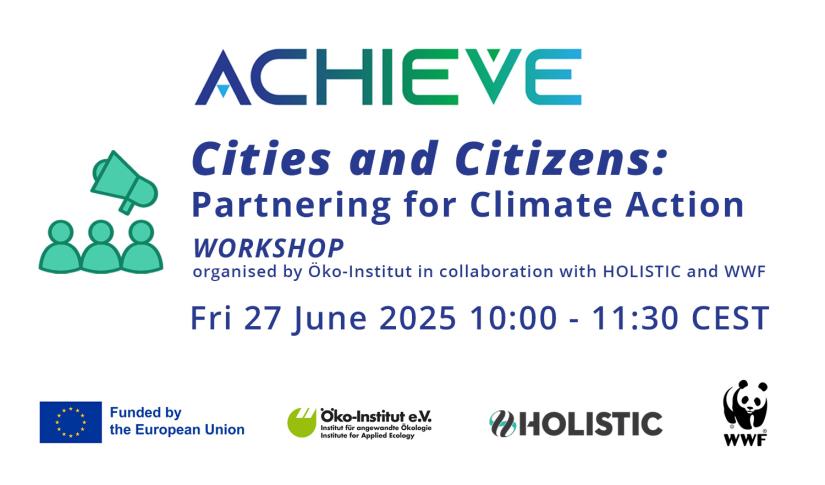
Webinar - Cities and Citizens Partnering for Climate Action


Context
The webinar, titled “Cities and Citizens: Partnering for Climate Action,” was hosted on June 27, 2025, as part of ACHIEVE Work Package 3.2. It provided a platform for city practitioners and civic initiatives from across Europe to share best practices, strategies, and barriers related to citizen engagement in local climate action. The event was structured in two main blocks: (1) the role of municipalities in fostering citizen involvement, and (2) citizen-led social innovations that enable collaborative governance. Speakers represented both municipal administrations and grassroots initiatives, offering a well-rounded view of top-down and bottom-up engagement models. A final Q&A session enabled further reflection and mutual learning.
The webinar was organised by Öko-Institut, in the context of the EU Horizon Europe project ACHIEVE and in collaboration with HOLISTIC and WWF.
Registration form (meeting has ended)
Meeting report (summary)
The ACHIEVE webinar underscored the critical role of participatory governance in advancing highintegrity voluntary climate action. Whether led by municipalities or citizen groups, successful initiatives share a common foundation: trust, ownership, and inclusive design. From Budapest’s participatory budgeting and citizen assemblies to Freiburg’s neighborhood-based climate districts and Münster’s community-driven Hansa Forum, the case studies illustrated that local engagement can meaningfully shape climate outcomes.
However, the presentations and discussion made clear that participation alone is not enough. Structural support is essential for citizen-led models to endure. Initiatives often falter when reliant on short-term project funding or overextended volunteers. As several speakers emphasized, longterm success depends on providing financial and institutional backing, clear roles, and the resources needed to build local capacity. Municipalities can serve as enablers by offering public space, technical assistance, and policy support—but they must also be willing to share power and adapt their frameworks to fit the needs of communities.
A key takeaway was that effective collaboration requires experimentation. Speakers from Münster and REScoop EU described how grassroots initiatives have pioneered new tools, from “common good” indices to revolving energy funds, and how these innovations have created ripple effects far beyond their local contexts. Many of these efforts thrive not despite but because of their bottom-up, iterative nature. Still, speakers also highlighted ongoing barriers: financial precarity, administrative silos, and the challenge of reaching underrepresented groups.
Lastly, the webinar highlighted the importance of peer learning and transnational exchange. The ACHIEVE platform created space for cities and communities across Europe to reflect on shared experiences and discover new strategies. As cities look toward 2030 and beyond, the message is clear: climate goals cannot be achieved through technical measures alone. They must be built with, by, and for the people who inhabit these cities. Only by embedding equity, accountability, and co-creation into climate action can we ensure the transition is not only effective—but just.
For a more detailed overview of the webinar, check the full webinar report and the presentations of the speakers below.
- Full webinar report
- Presentation by Julia Wegenast
- Presentation by Chris Vrettos
- Presentation by Lisa Kuehnemann